
“Most people aren’t resistant to AI. They’re resistant to uncertainty. When leaders talk about AI only in terms of efficiency or scale, teams are left to make sense of what it means for their own roles. Clear, human conversations matter just as much as the technology itself.” – Dave Pike, Discflow CEO
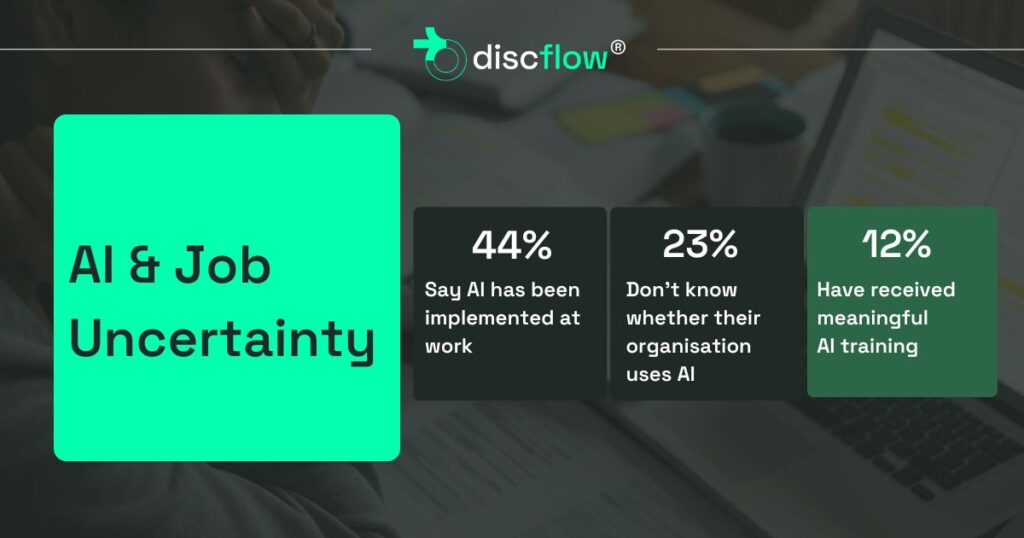
These patterns are reflected in wider workforce research. Gallup’s AI Use at Work research shows that 44% of employees say their organisation has already implemented AI, yet 23% are unsure whether AI is being used in their organisation at all, pointing to a clear communication gap. This is reinforced by EY’s Work Reimagined Survey, which highlights that while expectations for employees to adapt their skills are rising, only 12% report having received meaningful AI-related training. Together, these findings suggest that uncertainty around AI in the workplace is less about resistance to technology and more about how clearly people are informed, supported, and included as change accelerates.
Sources: EY Work Reimagined Survey (2025); Gallup AI Use at Work (2024–25)
The Two AI Conversations Happening at Work
When organisations talk about AI, two parallel narratives usually emerge. Leadership conversations about AI focus on:-
- Competitive advantage and innovation
- Removing inefficiency and friction
- Enabling people to do higher-value work
-
- Job security and long-term relevance
- Whether skills will still matter
- How roles might change without warning
- Resistant to change
- Behind the curve
- Lacking ambition or adaptability
What Employees Want to Know About AI
In our work with organisations, we consistently hear the same underlying needs from employees. People want clarity on what remains distinctly human in their role, confidence that judgment, relationships, and decision-making will continue to matter, and a sense of how they can grow alongside AI rather than compete with it. They’re not asking for guarantees; they’re asking for orientation.
The most effective leaders respond by neither over-promising nor over-reassuring. Instead, they acknowledge the tension directly and give people language to make sense of change. They talk openly about how AI may change some tasks without diminishing a person’s value, emphasise that technology handles speed and consistency while people bring judgment and relationships, and reinforce a focus on strengthening human capability alongside AI. Framed this way, AI becomes less of a threat and more of a context for growth.
Why Human Behaviour and Emotional Intelligence Matter More Than Ever
AI can analyse information, identify patterns, and increase efficiency. What it cannot do is read emotional context, build trust, or help people navigate uncertainty. As AI becomes more capable, distinctly human strengths become more visible, particularly in moments of change.
These strengths include:
-
Emotional awareness during change
-
Adaptability in complex, ambiguous situations
These capabilities shape how effectively teams respond to disruption and how well change is absorbed in everyday work. This is where we see Discflow add practical value. By combining behavioural insight with emotional intelligence, we help individuals and teams understand not just how they tend to behave, but how that behaviour shifts under pressure and uncertainty. We support people to recognise their default responses, reflect on impact, and make more intentional choices in how they communicate, lead, and work with others.
The future of work is shaped by how people and technology work together, and by how well organisations support the behaviours and conversations that change demands.
The Question Leaders Need to Ask NowThis shifts the question leaders need to ask. Instead of focusing solely on:
-
“How fast can we implement AI?”
A more useful question is:
-
“How well are we supporting people through what AI means for them?”
When people understand their place in the future and feel equipped to adapt, they engage with change. When they don’t, they quietly step back — not out of resistance, but uncertainty.
Final Thought The real risk with AI isn’t job loss tomorrow. It’s silent today. The organisations that succeed with AI will be the ones willing to host the conversations others avoid openly, honestly, and human-first.